


Showing posts with label gate free study materials.gate previous questions. Show all posts
Showing posts with label gate free study materials.gate previous questions. Show all posts
Friday, 19 September 2014

Saturday, 26 July 2014
20+ Years GATE Industrial Engineering Solved Questions

Industrial Engineering is an important section for GATE/PSU/IES Examinations where too many pointed questions were asked.In GATE examination up to 15 marks is allotted for this section.But The concepts are generally repeats in all exams. Exponential smoothing forecast method,Inventory Model,Linear Programming, Scheduling... etc are very important sections for all the exams.In this post I will give you best Industrial Engineering solved papers,which contains GATE previous questions from 1991 on wards with detailed explanations.The self explanatory solutions are very helpful for GATE Preparation.Click the below link to download the file.
20+ Years GATE Industrial EngineeringWednesday, 23 July 2014
ACE Study materials for engineering mathematics

Engineering mathematics is a vital area for GATE preparation, which consists of 15 marks in the exam.If we prepare well with maths basics all these 15 marks can be attained without that much difficulty.The questions generally asked from this section is relatively simple and direct.Here I attaches the ACE Academy study materials for Engineering Mathematics,which includes key points and practice problems.Prepare well with these materials and comment on this post to clarify your doubts.You can download the materials by clicking the below link.
ACE Study materials for engineering mathematics
Monday, 21 July 2014
875 Vacancies for Chargeman at Indian Ordnance Factories

Applications are Invited for Direct Recruitment of Chargeman ( Non-Gazetted Group ‘B’) at Indian Ordnance Factories located all over India under Ministry of Defense.
Apply Now
The Basic qualification is Diploma In Mechanical Engineering and Higher qualifications can also apply.


SELECTION PROCEDURE:
Selection will be made strictly on the merit of WRITTEN EXAMINATION to be notified in ofb.gov.in. There will be no Interview/Personality Tests. A provisional list of successful candidates will be published.
The date, time and venue of the written examination will be fixed by the OFB and will be intimated to the eligible candidates in due course.
Based on the performance of candidates in the written examination, candidates equal to number of vacancies shall be called at NADP/Respective Factories for document verification.
Discipline/Trade-wise provisional select list would be displayed in order of merit in website ofb.gov.in.The appointment of selected candidates is subject to his/her passing requisite Medical Fitness Test to be conducted by the concerned Ordnance Factory Administration, final verification of education, community certificate and verification of antecedent/character of the candidate.
The Successful Candidates will be issued with ‘Appointment Letter’ only after completion of above activity and PVR (Police Verification Report).


All questions will be Objective type with multiple choices. There will be negative marking of 1/4 of the marks allotted for each wrong answer.
MEDIUM OF EXAMINATION: ENGLISH or HINDI
Heat and Mass Transfer by Younus Cengel
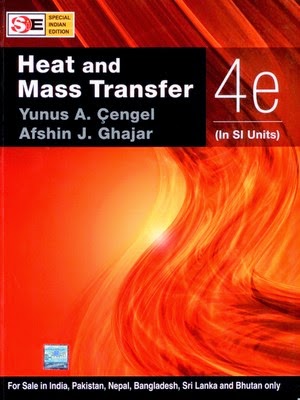
Heat and Mass Transfer is an important section for all the competitive exams of Mechanical Engineering, Cengel's HMT is one of the best book for theory as well as problems.The author starts from the basics and leads us to the in depth of subject.The book comprises above 900 pages and theoretical explanations to the most of the practical problems.One of the most important feature of this book is that the problems of this text are practically important. This book is highly useful for those who preparing for IES/GATE/ PSU exams to get the core concepts.There are several solved exercises and and clearly explained.The book flows like reading a story through the detailed explanation of each and every concept.The soft copy of the book can be downloaded from the below link.The hard copy can be bought from the flipkart at a discount rate than local retail stores.
Download E Book Buy Book
Saturday, 19 July 2014
Important Topics to Score More in GATE

GATE, like any other competitive examination, demands selective study. If one is appearing for GATE Mechanical examination, there are a few topics which must not be missed. Meticulous planning and conceptual clarity on the following topics can help improve a candidates’ rank by several notches.
1 | Engineering mechanics | Equilibrium of rigid bodies, structural analysis, Impulse and momentum, Rectilinear kinematics, Work and Energy, Law of Restitution |
2. | Strength of Materials | Stress and strain, Theory of bending, Beam deflection, Torsion in shafts, Bi-axial stress and strain, Mohr’s circle, Thin-walled shells, Equilibrium, Struts and columns |
3. | Theory of Machines | Mechanisms and machines, Flywheel, Friction, Gears, Kinematic analysis |
4. | Vibrations | Undamped vibrations, Free damped vibrations, Forced vibrations |
5. | Design | Static loading, Dynamic loading, Threaded joints, Riveted joints, Welded joints, Design of gears, Belt drives/brakes, bearings |
6. | Fluid Mechanics | Fluid properties, Fluid pressure, Flow measurements, Kinematics of fluid flow, Principles of fluid flow, Laminar pipe flow, Boundary layer theory |
7. | Heat Transfer | Conduction, Convection, Radiation, Heat exchangers |
8. | Thermodynamics | Basic concepts, First law, Second law, Exergy and irreversibility, Properties of gases, Gas compression, Brayton cycle |
9. | Applications | IC engines, Refrigeration and air-conditioning, turbo machinery, Power engineering |
10. | Material science | Heat treatment of steel, Iron-carbon phase, mechanical properties, Crystal structure, Effect of imperfections |
11. | Casting | Gating system, Casting defects, Pattern |
12. | Forming | Rolling, Extrusion, Sheet metal forming, forging, Modern forming processes |
13. | Welding | Welding processes |
14. | Machining | Mechanism of metal cutting, Machining processes, Machinability, Modern machining processes |
15. | Metrology | Limits, tolerances and fits, Linear measurements, Gauge design |
16. | Computer Integrated Manufacturing | Computer aided design, Numerical control |
17. | PPC | Forecasting, Break-even analysis, Assembly line balancing, Functions of PPC, MRP |
18. | Inventory Control | Basic concepts, EOQ models, |
19. | Operation Research | Simplex method, Transportation problems, Queuing, Sequencing, PERT and CPM, Break-even analysis |
Courtesy from http://www.gate.wileymaestro.com/
GATE Mechanical Syllabus

Engineering Mathematics
Linear Algebra: Matrix algebra, Systems of linear equations, Eigen values and eigen vectors.
Calculus: Functions of single variable, Limit, continuity and differentiability, Mean value theorems, Evaluation of definite and improper integrals, Partial derivatives, Total derivative, Maxima and minima, Gradient, Divergence and Curl, Vector identities, Directional derivatives, Line, Surface and Volume integrals, Stokes, Gauss and Green’s theorems.
Differential equations: First order equations (linear and nonlinear), Higher order linear differential equations with constant coefficients, Cauchy’s and Euler’s equations, Initial and boundary value problems, Laplace transforms, Solutions of one dimensional heat and wave equations and Laplace equation.
Complex variables: Analytic functions, Cauchy’s integral theorem, Taylor and Laurent series. Probability and Statistics: Definitions of probability and sampling theorems, Conditional probability, Mean, median, mode and standard deviation, Random variables, Poisson,Normal and Binomial distributions.
Numerical Methods: Numerical solutions of linear and non-linear algebraic equations Integration by trapezoidal and Simpson’s rule, single and multi-step methods for differential equations.
Applied Mechanics And Design
Engineering Mechanics: Free body diagrams and equilibrium; trusses and frames; virtual work; kinematics and dynamics of particles and of rigid bodies in plane motion, including impulse and momentum (linear and angular) and energy formulations; impact.
Strength of Materials: Stress and strain, stress-strain relationship and elastic constants, Mohr’s circle for plane stress and plane strain, thin cylinders; shear force and bending moment diagrams; bending and shear stresses; deflection of beams; torsion of circular shafts; Euler’s theory of columns; strain energy methods; thermal stresses.
Theory of Machines: Displacement, velocity and acceleration analysis of plane mechanisms; dynamic analysis of slider-crank mechanism; gear trains; flywheels. Vibrations: Free and forced vibration of single degree of freedom systems; effect of damping; vibration isolation; resonance, critical speeds of shafts.
Design: Design for static and dynamic loading; failure theories; fatigue strength and the S-N diagram; principles of the design of machine elements such as bolted, riveted and welded joints, shafts, spur gears, rolling and sliding contact bearings, brakes and clutches.
Fluid Mechanics and Thermal Sciences
Fluid Mechanics: Fluid properties; fluid statics, manometry, buoyancy; control-volume analysis of mass, momentum and energy; fluid acceleration; differential equations of continuity and momentum; Bernoulli’s equation; viscous flow of incompressible fluids; boundary layer; elementary turbulent flow; flow through pipes, head losses in pipes, bends etc.
Heat-Transfer: Modes of heat transfer; one dimensional heat conduction, resistance concept, electrical analogy, unsteady heat conduction, fins; dimensionless parameters in free and forced convective heat transfer, various correlations for heat transfer in flow over flat plates and through pipes; thermal boundary layer; effect of turbulence; radiative heat transfer, black and grey surfaces, shape factors, network analysis; heat exchanger performance, LMTD and NTU methods.
Thermodynamics: Zeroth, First and Second laws of thermodynamics; thermodynamic system and processes; Carnot cycle.irreversibility and availability; behaviour of ideal and real gases, properties of pure substances, calculation of work and heat in ideal processes; analysis of thermodynamic cycles related to energy conversion.
Applications: Power Engineering: Steam Tables, Rankine, Brayton cycles with regeneration and reheat. I.C. Engines: air-standard Otto, Diesel cycles. Refrigeration and air-conditioning: Vapour refrigeration cycle, heat pumps, gas refrigeration, Reverse Brayton cycle; moist air: psychrometric chart, basic psychrometric processes.
Turbomachinery: Pelton-wheel, Francis and Kaplan turbines — impulse and reaction principles, velocity diagrams. Manufacturing and Industrial Engineering Engineering Materials: Structure and properties of engineering materials, heat treatment, stress-strain diagrams for engineering materials.
Metal Casting: Design of patterns, moulds and cores; solidification and cooling; riser and gating design, design considerations.
Forming: Plastic deformation and yield criteria; fundamentals of hot and cold working processes; load estimation for bulk (forging, rolling, extrusion, drawing) and sheet (shearing, deep drawing, bending) metal forming processes; principles of powder metallurgy.
Joining: Physics of welding, brazing and soldering; adhesive bonding; design considerations in welding.
Machining and Machine Tool Operations: Mechanics of machining, single and multi-point cutting tools, tool geometry and materials, tool life and wear; economics of machining; principles of non-traditional machining processes; principles of work holding, principles of design of jigs and fixtures
Metrology and Inspection: Limits, fits and tolerances; linear and angular measurements; comparators; gauge design; interferometry; form and finish measurement; alignment and testing methods; tolerance analysis in manufacturing and assembly.
Computer Integrated Manufacturing: Basic concepts of CAD/CAM and their integration tools.
Production Planning and Control: Forecasting models, aggregate production planning, scheduling, materials requirement planning.
Inventory Control: Deterministic and probabilistic models; safety stock inventory control systems.
Operations Research: Linear programming, simplex and duplex method, transportation, assignment, network flow models, simple queuing models, PERT and CPM.
GATE General Aptitude Syllabus
General Aptitude (GA): Common to All Papers
1. Verbal Ability: English grammar, sentence completion, verbal analogies, word groups, instructions, critical reasoning and verbal deduction.2. Numerical Ability: Numerical computation, numerical estimation, numerical reasoning and data interpretation.
Sample Questions Verbal Ability
Q.1. Choose the appropriate answer to complete the following sentence: After several _____________ attempts to send the missile into space, the spacecraft were finally launched successfully.
(A) abortive (B) difficult (C) experimental (D) preliminary
Ans. (A)
Q.2. Choose the appropriate answer to complete the following sentence: Medicine is to illness as law is to _____________.
(A) discipline (B) anarchy (C) treason (D) etiquette
Ans. (B)
Q.3. Read the following paragraph:
“The ordinary form of mercury thermometer is used for temperature ranging from –40oF to 500oF. For measuring temperature below –40oF, thermometers filled with alcohol are used. These are, however, not satisfactory for use in high temperatures. When a mercury thermometer is used for temperature above 500oF, the space above the mercury is filled with some inert gas, usually nitrogen or carbon dioxide, placed in the thermometer under pressure. As the mercury rises, the gas pressures is increased, so that it is possible to use these thermometers for temperatures as high as 1000oF.”
With what, besides mercury, would a thermometer be filled if it was designed to be used for measuring temperature of about 500oF?(A) Pyrometer (B) Inert gas (C) Iron and brass (D) Gas
Ans. (B) 26
Q.4. The cost of manufacturing tractors in Korea is twenty percent less than the cost of manufacturing tractors in Germany. Even after transportation fees and import taxes are added, it is still cheaper to import tractors from Korea to Germany than to produce tractors in Germany.
Which of the following assertions is best supported by the above information?
(A) Labour costs in Korea are twenty percent below those in Germany.
(B) Importing tractors into Germany will eliminate twenty percent of the manufacturing jobs in Germany.
(C) The costs of transporting a tractor from Korea to Germany are more than twenty percent of the cost of manufacturing the tractor in Korea.
(D) The import taxes on a tractor imported from Korea to Germany is less than twenty percent of the cost of manufacturing the tractor in Germany.
Ans. (D)
Numerical Ability
Q.5. In a survey, 3/16 of the people surveyed told that they preferred to use public transport while commuting daily to office. 5/8 of the people surveyed told that they preferred to use their own vehicles. The remaining 75 respondents said that they had no clear preference. How many people preferred to use public transport?
(A) 75 (B) 100 (C) 125 (D) 133
Ans. (A)
Friday, 18 July 2014
Books for GATE Preparation

List of books to be used for different subjects of mechanical engineering.
1. Advanced Engineering mathematics by
- a. Erwin kreyszig (John wiley & sons publication) (strongly recommended)
- b. Dr.B.S.Grewal (Khanna publications) (strongly recommended)
2. Engineering mechanic (statics and dynamics) by
- a. Beer and Johnston (the Tata McGraw Hill publications)
- b. Prof. P.J.shah (few but various enough examples - good book)
3. Strength of material by
- a. G.H.Ryder (English Language Book society)
4. Theory of machines by
- a. Amitabh Ghosh and Ashok kumar mallik ( Affiliated East –West press private Limited)
- b. S.S. Rattan ( The Tata McGraw Hill publications)
5. Machine design by
- a. R.S.Khurami ( S.Chand & sons publication)
6. Vibrations by
- a. V.P.singh
7. Fundamentals of thermodynamics by
- a. P.K.Nag (The Tata McGraw Hill publications)
- b. Van Whylen (John wiley & sons publication)
8. Refrigeration and Air conditioning by
- a. R.K.Rajput (thermal science and engineering) (Laxmi publications)
- b. http://nptel.iitm.ac.in/ This is the website developed by the IITs.
9. Applied thermodynamics
- a. R.K.Rajput (thermal science and engineering) (Laxmi publications)
10. Heat and Mass transfer by
- a. Yunus A.cengel (The McGraw-Hill companies)
11. Fluid mechanics and machines
- a. Dr.R.K.Bansal (Laxmi publications) (strongly recommended)
- b. Yunus A.cengel (The McGraw-Hill companies)
12. Manufacturing science by
- a. P.N.Rao (volume 2 and 3) (The Tata McGraw Hill publications)
- b. Amitabh Ghosh and Ashok kumar mallik ( Affiliated East –West press Private limited)
- c. P.C.Sharma d. S.Kalpakjian (Pearson Education)
13. Management science and Operations management
- a. Hamdy A.Taha (operations research)( prentice hall of India privet limited)
- b. William J. Stevenson ( introduction to management science)(IRWIN pub)
- c. B.Mahadevan (Operations management) (Dorling Kindersley (India)Privet limited)
- d. J.K.sharma (operations research)
Besides this previous 10 to 12 years solved GATE papers are needed.
Subscribe to:
Posts (Atom)


